
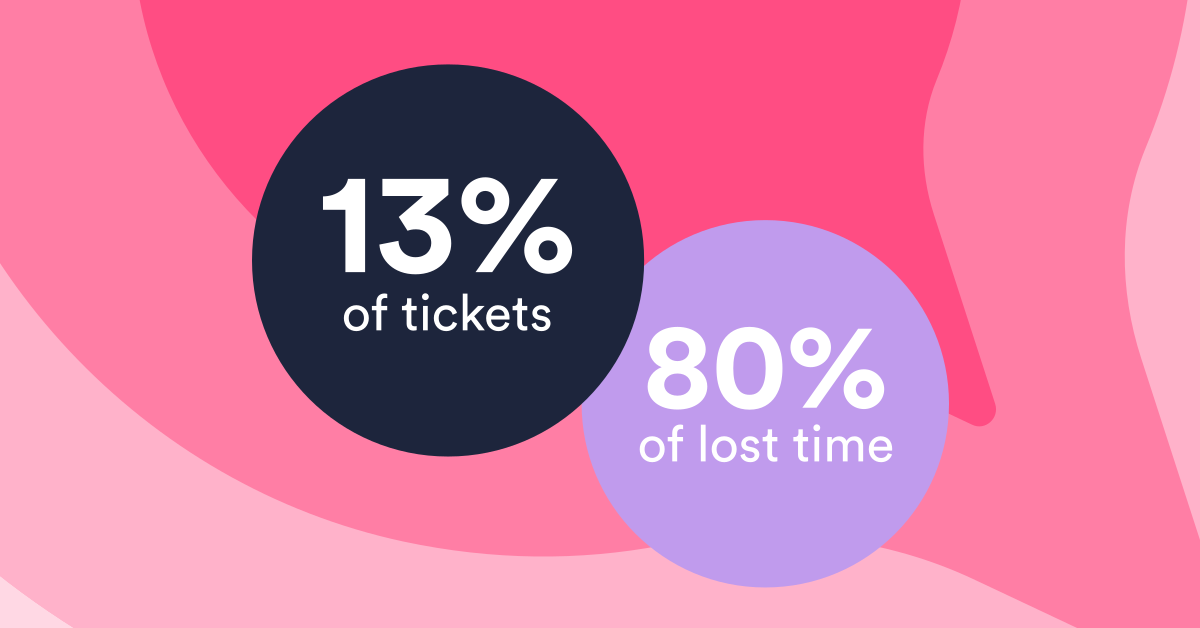
Most CIOs know their CSAT score, but almost none know which 13% of tickets are causing 80% of their lost productivity
Ask any CIO how IT is doing and you'll get a number fast. Maybe CSAT is up two points, or response times are down, or something like that. Now, ask the same CIO which specific services are quietly costing the business the most productivity, and the room goes quiet. That gap between a confident score and no visibility into what's actually driving it is the single most expensive blind spot in enterprise IT, and almost nobody has built the reporting to close it. 😱

Call it the watermelon effect: green on the outside, red on the inside: SLAs are met, CSAT looks respectable, and yet, employees are still losing meaningful chunks of their day to friction that never shows up in an operational report.
It's because operational reports were built to measure what IT controls, not what employees actually experience. A ticket can be closed within SLA and still cost someone half a morning. An application can meet its uptime target and still be the reason a whole department works around it rather than with it.
The scale of this is not trivial.
Employees lose an average of 3 hours and 18 minutes of productive time per IT incident.
Within that average, a small slice of tickets is doing most of the damage: roughly 13% of tickets drive 80% of the lost productivity. A CSAT score is an average, and averages are exactly what hide a problem like this: a handful of high-friction services or issue types can drag down thousands of people's days while the topline number still looks fine on a slide.
This data is from our Global IT Experience Benchmark 2026. You can read the full report here!
This matters more, not less, as IT budgets face harder scrutiny and automation and AI investment decisions get bigger.
A CIO who can't say where lost productivity is actually concentrated is making roadmap and budget calls on incomplete information, and defending them to the CFO with a satisfaction score instead of a business case.
The approach: two metrics, benchmarked, AI-summarized
Closing that gap requires more than another survey.
HappySignals is an IT experience intelligence platform designed specifically to answer the question CSAT can't. And it's not just about how employees feel, but about how much time and productivity that feeling is actually costing.
Two connected metrics, happiness and lost time, sit alongside your operational data, get benchmarked against comparable organizations, and get summarized by AI into the specific patterns worth acting on.
It's an additional intelligence layer that turns continuous employee feedback into a business case a CFO or CHRO can actually act on.
That's the difference between reporting a score and running the business on data. A satisfaction number like CSAT simply tells the board IT is doing fine, but a lost-time figure, tied to the specific 13% of tickets driving it, tells the board exactly where the next quarter's IT investment should go. And what's more, it gives you the evidence to defend that call.
Two objections tend to surface at this point in the conversation, and both are worth addressing directly.
The first is budget: We don't have room for another tool right now.
The average HappySignals customer recovers roughly 26% of lost time in year one. For an organization of a few thousand employees, that's a productivity return large enough to build the business case before it ever reaches procurement, not after.
The second is deployment risk: This sounds like a big project.
It isn't. The model is research-backed survey design plus certified integrations into the platforms you already run, with most customers live and collecting trusted data within days, not months.
The point of entry, the Discover package, exists specifically so a CIO can see real data in their own environment before committing to anything larger.
Proof: what this looks like at scale
Dr. Ozan Acar, Head of the CIO Office at AhlstromMunksjö, described the effect on both sides of the equation: focusing on experience led to a 150% increase in happiness and a 57% increase in productivity.
And Christopher Woods, CIO at Campari Group, framed the strategic stakes plainly: "A CIO working without Experience Data would be like a Sales Manager working without CRM."
No CRO would run a sales org on gut feel and a single satisfaction survey. Most CIOs are still running IT that way, with a CSAT score standing in for the operational intelligence every other function in the business now expects.
What changes when you can see the 13%
Once lost productivity is visible at the ticket level, the CIO conversation changes shape.
Instead of defending a satisfaction score in a board meeting, you present a business case: this specific set of services is costing the organization this many hours, here's the fix, here's the expected return.
Instead of allocating the next automation or AI investment based on which team shouts loudest, you allocate it based on where the data says the friction actually concentrates. And instead of learning about a systemic problem from an escalation, you catch it in the trend weeks before it becomes one.
It also changes how IT is discussed at the executive level. A CIO who can walk into a board conversation with a specific, quantified productivity number, like recovered hours and not just a happiness score, is having a fundamentally different conversation than one relying on CSAT alone.
It's the difference between IT as a cost center defending its budget and IT as a function that can prove its return.
Most CIOs will keep being able to answer "what's your CSAT score" without hesitation.
Very few will be able to answer "which 13% of tickets is costing you the most" until they start measuring it.
That gap is closing fast for the CIOs who've decided a satisfaction score isn't enough anymore.
See where your lost productivity actually concentrates. Start with Discover and see the value in days, not months.

One insight a month, in your inbox.
New articles, benchmark data, and customer stories. No fluff.