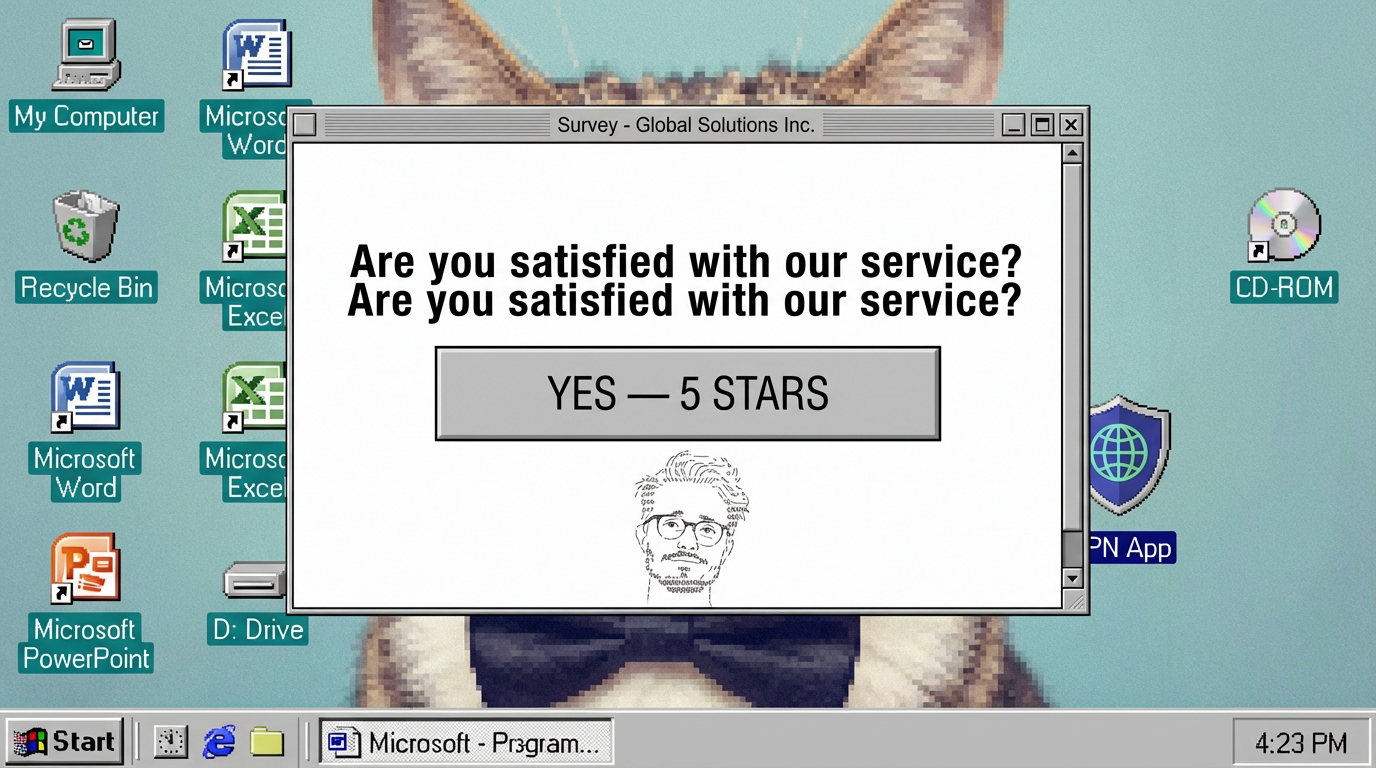
If the score goes up, things must be getting better. At least, that’s what the slide with the improved CSAT score will attempt to tell us. But what if the only thing that changed was the survey?
The hidden weakness of CSAT is that it’s incredibly easy to move the number without improving the experience behind it. Just make it easier to give a good score! ★★★★★!
CSAT measures a reaction, not reality
CSAT feels objective because it’s a number and it trends nicely. Leadership understands it instantly.
But what it mostly reflects is simply how easy it was to answer the question, not how it felt to deal with the issue.
An employee can click five stars:
while their VPN drops again(hehee)
while they waited days for an update
while the ticket was technically closed, but nothing improved
The score looks fine, but it’s, in fact, not fine.
But the question is : How do you improve CSAT scores in IT?
When the metric improves, but nothing else does
This is where many teams get misled. A higher CSAT score suggests progress, even when the underlying service hasn’t changed.
Worse, CSAT usually represents a very small group of respondents. A few percent of users decide the narrative for everyone else. The people who respond are often the ones who had the energy to click, not the ones who were most blocked or frustrated.
You end up optimizing IT for the metric rather than the experience.
Designed for reporting, not for learning
Over time, CSAT surveys tend to drift. Stars can become smiley faces, questions get simplified, friction is removed to improve the score...
The data becomes easier to explain, but less useful.
Instead of learning what’s broken, teams learn how to make the number behave.
At that point, CSAT stops being feedback and starts being reassurance.
Experience needs context, not just a score
A single score cannot explain:
what actually caused frustration
where delays happened
which services or vendors failed
why work could not continue
Experience becomes meaningful when it’s connected to what actually happened in ITSM.
Which ticket was this about?
What service was involved?
How long did the employee wait, and for what?
Without that context, CSAT answers the least important question: Did someone click something positive?
From comforting numbers to useful insight
Improving the experience isn’t about inventing better surveys to get people to give higher scores. It’s about collecting real experience data you can trust and act on.
That means moving beyond standalone scores toward experience grounded in real incidents, real requests, and real outcomes.
If the score improves but the experience doesn’t, you’ve learned nothing at all.
One insight a month, in your inbox.
New articles, benchmark data, and customer stories. No fluff.