


Podcast: How Aldi Süd stopped trusting its green dashboards
Every IT leader I talk to knows the feeling: staring at a dashboard glowing green while quietly knowing the business is unhappy.
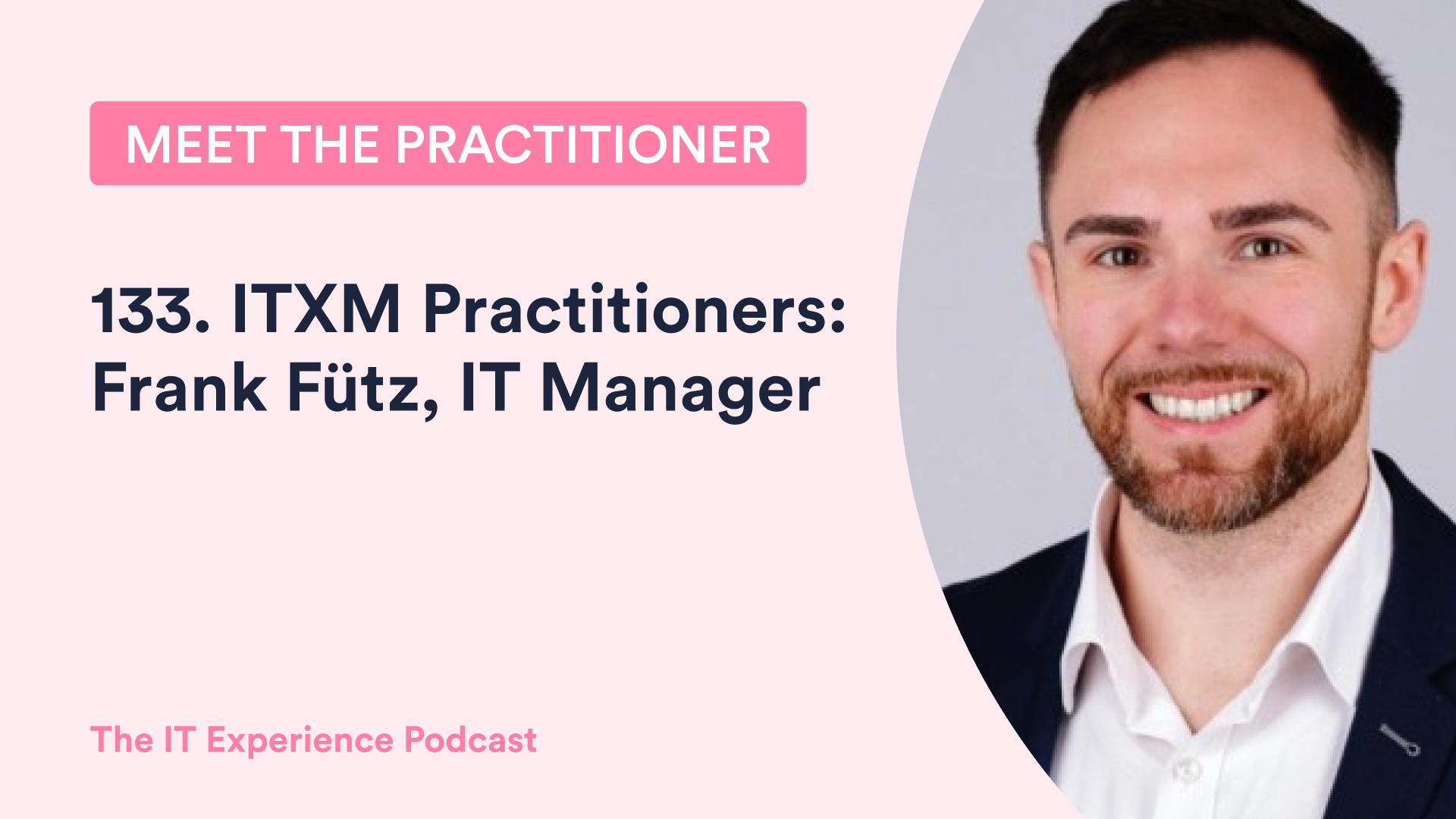
When we sat down with Frank Fuetz, IT Manager at Aldi South, we discussed how a global grocery retailer (7,000+ stores, 180,000+ employees, 11 countries, and more than 600 IT products) moved from SLAs that looked perfect to a way of working built around actual experience.
An accidental introduction to XLAs
Frank didn't arrive at IT experience management through the usual service desk route. He came from operating model design and CIO advisory, and stumbled into ITXM while leading a team of process owners tasked with fixing SLA management.
Then his boss forwarded him a Gartner article, the kind of forward Frank admits he usually braces himself to argue with.
This one was about experience level agreements (XLAs). His first reaction was skepticism: another buzzword built to get internal buy-in from decision-makers.
But the more he read, the more it named his exact problem! A vendor evaluation, a concept, and a pilot later, the results were, in his words, eye-opening. Three years on, Aldi Süd is still expanding the program.
Why the smiley face is never enough
Aldi Süd ran CSAT before any of this: A survey sent after every incident. Response rates sat below 3%.
As in many organizations, even today, there was no strategy behind it, no decent dashboards. When Frank asked business leaders whether they even knew the survey existed, the answer was no, even though their own people had answered it.
This is the heart of the matter, and it's the argument I keep coming back to: a thumbs-up or a five-star rating tells you almost nothing on its own.
What changed things at Aldi wasn't a new way of calculating a score. It was the whole system around it. The communication, the process, the motivation, and a platform visual enough that people actually wanted to engage with it.
Suddenly, everyone was talking about it!
KPIs don't disappear, they get a better job
Frank was careful here, and it's worth repeating: SLAs and KPIs don't go away.
Aldi still has plenty. The difference is they're no longer optimized for their own sake.
The team now starts with experience (where people are struggling) and then drills into the relevant SLAs and KPIs to understand why. Maybe one user group sees longer resolution times, or maybe a service is quietly painful to request.
Traditional KPIs tell you how teams are performing, not how employees feel, and that the temptation to "stop the clock" by parking a ticket is exactly the kind of metric-gaming experience data exposes.
The real shift is one of mindset.
Closing the loop is the whole game
The biggest risk Frank named is survey fatigue, which he called the death of it all.
Ask people repeatedly, make no changes, and they stop responding. Research backs it up: the number one cause of survey fatigue is doing nothing with the data.
Aldi's answer is to close the loop visibly. In a warehouse management pilot, a critical part of the value chain, the team added experience data into their quarterly prioritization, then told users what they'd heard and what they were changing.
Spotting friction in request management, they rolled out several new standard service requests. People could see their feedback turn into action, directly!
This laptop story makes the case even more plainly.
Early feedback was brutal, occasionally in all caps, though Frank notes most colleagues stayed remarkably polite ("it's all crap, please change everything, thank you in advance" 😅).
A hardware refresh was already on the roadmap, but the experience data reshaped how and how fast it happened. After the new models landed, the happiness score jumped more than 100 points.
🎧 PS. Check out the full podcast episode here.
Where this is heading
Aldi Süd is now scaling organization-wide, with roughly 50 nominated IT experience coordinators across business units driving adoption. For Frank, it's a dream three years in the making.
His closing argument was simple: Experience management belongs at the centre of every IT management system.
Traditional KPIs have their place, but they don't neatly align with business goals. Experience bridges that gap. It's better for the humans and the business.
The information is all there, handed to you on a plate. You just have to do something with it. 😌

Related content

04.10.2017
Employee Experience vs Customer Satisfaction: Why you need to know the difference
For many years, businesses have agonised over understanding and improving customer satisfaction. From ‘putting ...
Read more >
03.02.2020
Internal Service Desks make Employees 47% More Productive with XLA?
Internal Service Desks make employees 22% happier and 47% more productive compared to Outsourced Service Desks, due to ...
Read more >