
How much is digital friction actually costing your business?
IT leaders are under more pressure than ever to prove that technology investments drive productivity, not just uptime. Most IT organizations respond with the metrics they have: SLA compliance, ticket volumes, resolution times, or CSAT scores. We think these are the wrong metrics for the question being asked.

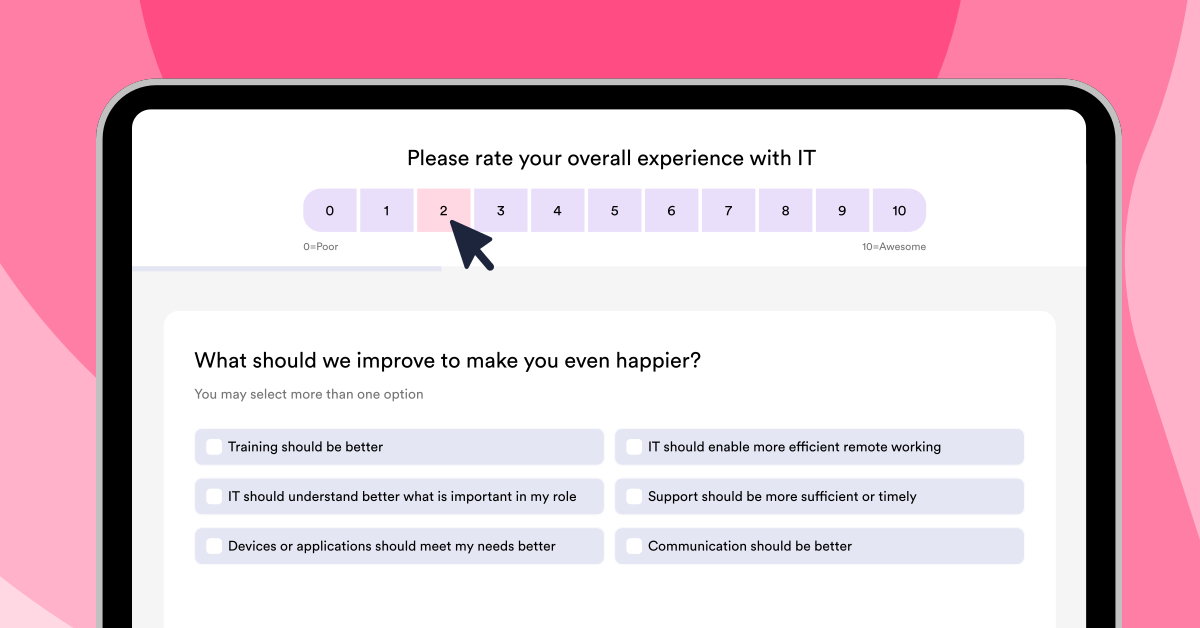
Every time an employee contacts IT (or gives up and works around a problem instead), time is lost. Not just the minutes spent on the ticket, waiting for a response, or figuring out a workaround.
It's also all the time wasted when a ticket gets reassigned, and the employee has to re-explain their problem, as well as the cognitive overhead of dealing with technology that doesn't work the way it should.
This is digital friction. And in most organizations, it's completely invisible in IT reporting. The reason is straightforward: traditional IT metrics measure IT activity, not employee impact.
Metrics like SLAs, ticket volumes, and CSAT don't measure what the problem costs the business in employee time and productivity before, during, and after the ticket is resolved.
What the data actually shows
In the HappySignals Global IT Experience Benchmark, the lost time metric, a.k.a. how long employees report losing to IT issues, tells a consistently striking story.
On average, employees lose over an hour of productive time per IT incident. But that average conceals lots of variation.
A small proportion of ticket types drives a disproportionate share of total lost time. In most organizations, roughly 13% of tickets account for approximately 80% of all lost productivity. The rest has relatively limited business impact.
This means most IT organizations are optimizing for the wrong things. They're measuring and improving the high-volume, low-impact ticket types because that's where the ticket numbers are.
The high-impact, high-cost issues that are quietly draining hours from the business stay invisible because nobody is measuring them in business terms.
At Ahlström-Munksjö, focusing on employee experience alongside IT metrics led to a 150% improvement in happiness scores and a 57% improvement in productivity.
That's not a technology metric; it's a real business result, and it came directly from understanding where digital friction was happening and then acting on it.
Why this matters for the conversation you need to have
The pressure on IT leaders to prove business value isn't going away.
As AI investments grow and IT budgets face greater scrutiny, the ability to connect IT performance to business outcomes becomes a strategic necessity.
Lost time data gives you that connection, translated into the experience your employees are having with IT. This is something that previously lived only in CSAT scores and anecdotal feedback, and now we see it as hours, productivity, and cost.
How to find your number
The starting point is simpler than most IT leaders expect.
You don't need a complex productivity study or a lengthy benchmarking exercise. You need two things: a way to measure how much time employees lose to IT issues from their perspective, and a way to connect that lost time to the specific services, ticket types, and workflows where it occurs.
When you have that data, three things become possible.
First, you can prioritize IT improvements by business impact rather than ticket volume, focusing resources on the 13% of issues that drive 80% of lost productivity rather than optimizing across the board.
Second, you can build a credible ROI narrative for IT investments. Instead of talking about things like reducing MTTR by 12%, you can talk about the hours of productivity recovered by fixing specific friction points.
Third, you can have a different conversation with leadership, such as the measurable business value IT created in a specific time frame.
The question worth answering
Your CSAT score tells you whether employees were satisfied with IT support and your SLA data tells you whether IT responded in time, but neither tells you what digital friction is actually costing your business.
That number exists. It's sitting in the gap between your technical metrics and your employees' daily experience. Finding it is where the real IT business case begins!
HappySignals is the Experience Intelligence platform that measures the human experience of IT and turns continuous employee feedback into the intelligence that helps you make better decisions and drive real business impact.

One insight a month, in your inbox.
New articles, benchmark data, and customer stories. No fluff.